
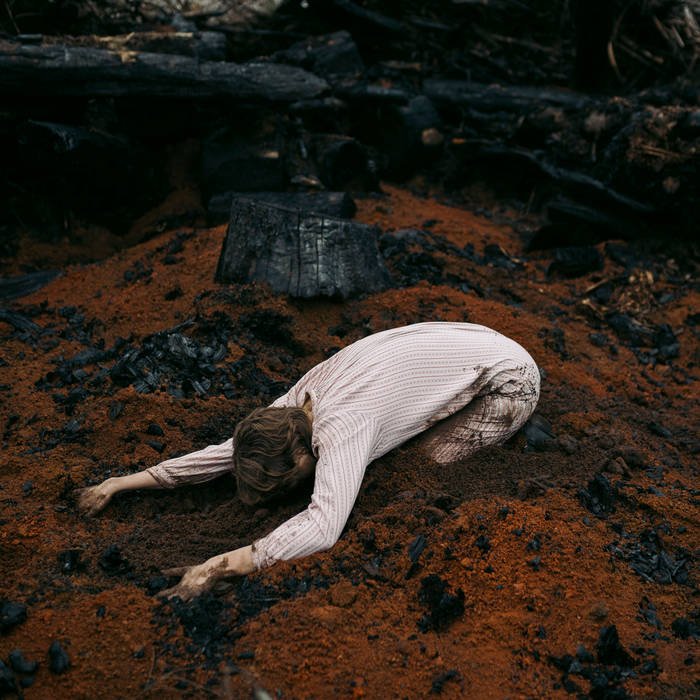
Serving as an invitation for listeners into a world of self-reclamation, and drenched in earthy tones rooted in the woods of Vermont, Hannah Frances’, ‘Keeper of the Shepherd‘ showcases her ability to craft intricate folk music that is driven by detailed and moving storytelling. This follow up to her 2021 record, ‘Bedrock,’ is spellbinding, enchanting, and a wholeheartedly-inspiring display of the challenge that is recovery and renewal after grieving. With it’s rich blend of acoustic instrumentation and evocative lyrics, the album paints vivid pictures of the tests of personal growth and transformation, while still highlighting the beauty in the struggle of the journey. The elegance in the execution of the layers and nuances of the LP is what makes it so immersive.
The poetic nature of the album is immediately evident, as Frances opens the first track, “Bronwyn,” with “the brilliance of the day waits for you to wake again, patient in the way I waited for you to love me again.” While it is grief that echoes throughout this track list, it is not without contention by Frances’ unwavering confidence, and a clear desire for the restoration of herself. The record consistently and seamlessly shows the Chicago-based singer/songwriter’s ability to deliver deeply contemplative and introspective songs, with both explosive and restrained timbre. The title track (“Keeper of the Shepherd“) features convicting and assertive vocals that carry a breathtaking momentum, highlighted by a shining use of vibrato that commands the attention of the listener. Meanwhile, track 5, “Husk“, further exhibits Frances’ versatility and connection with the earth. The song brings a slow and elegant approach to detailing the cyclical nature of life and death on earth, the process of transformation, and how these elements interweave to shape our existence.
I remember every empty hand
Vacant Intimacies, Keeper of the Shepherd (2024)
Every echoing cave that never gave back
I remember every hollow home
Grasping to the absence, haunted by the lack
Grasping to the absence, haunted by the vacant intimacies
Not only is ‘Keeper of the Shepherd‘ abundant in emotional offerings poetically, but it is also rich sonically with its lush instrumentation and textures that build astounding depth to the album. It is truly synonymous with nature, providing earthy tones with tenderly woven acoustic guitar play, warm piano lines, and even a velvety appearance of the saxophone. Subtle, yet meticulously crafted string arrangements also gorgeously enhance the emotional resonation of the instrumentation. This delicate interplay among these elements helps to elevate the depth of her words as well. It is truly both intimate and evocative—and organic to its core. This all comes together in unique ways throughout the 7-track effort, creating an overall diverse soundscape for Frances’ poetic prowess to shine.
I was fortunate enough to have the opportunity to connect with Hannah in regards to the record. Our communications highlighted her relationship to the album, creative influences, and the interdisciplinary nature of the whole album experience.
One of my favourite aspects of the album is the vast use of earthy elements. Whether it is the evocative imagery in the lyrics, to the rich instrumentation, the album feels down to earth in a literal sense. How did the natural world influence the soundscapes created on the LP?
My writing is very inextricable from my relationship with the land! I’ve spent a lot of time healing with plants, exploring landscapes, listening to landscapes, and understanding the ecology of place. As a poet, I am always weaving ecological imagery to express my lived human experience, and find that my kinship with moss, birds, rivers, trees, snakes, deer, crows, husks, roots, etc. helps me feel more connected to the world. And when I feel connected to the outer world’s landscape, I feel connected to my inner landscape, and from that place I can access a deeper spiritual understanding of why I am here, at this time, in this life. The land has all the answers to my questions, all of my human desires and yearnings and heartache. It is so sentient and communicative if you learn to listen.
Furthermore on the earthy tones of the album, I like to use nature as an outlet for staying grounded and stress-relief. I’m curious how you view the role of nature in the themes of this album and in life?
Likewise I relate to nature as a way to feel more grounded. My life revolves around the cycles of nature, in flow with it, which I think we all need more of and this world would be more rich, peaceful, and connected if everyone re-aligned their lives with the rhythm of nature instead of working against it and causing harm. This album was very much written in that place of alignment and rhythm, as I was living here in Vermont and nestled in the woods, in a place of vast clarity and connection not just with spirit but with the tangible land, sheep, animals, and ground around me. With the season, with the food growing, witnessing the decaying and dying of the land as the year turned from autumn into winter. My observations were of the land around me, reflecting my inner processing. This is life, or at least how I want to live as a land-based artist.
Can you speak on the impact of Chicago and Vermont in your artistry, even outside of Keeper of the Shepherd?
Yes! City life and rural life both have such magic to them, and I feel nourished by both in different ways. I was transient for the greater part of the last decade, living in Manhattan, Brooklyn, Philadelphia, Northern California to study herbal medicine, back to NYC, back to where I grew up in Pennsylvania, up to Vermont then to Chicago, then back to Vermont. Traveling and farming around the US and abroad, from the UK all through Europe to Morocco and back. My 2021 album Bedrock was written all over, during 2019 and 2020, through a lot of movement and capturing different places, ultimately in pursuit for a sense of home or a bedrock. I have cultivated a rich and well-rounded creative practice and artistic perspective through this movement, through traveling this country extensively, witnessing myself in different environments, shapeshifting, reflecting. I’m very porous and impressionable by my environment. The city agitates me in ways that fuel creative breakthroughs, through a feeling of pressure and frenzy. My writing reflects that energy when I’m in the city, I can be more detached from the land, different imagery comes through me, different emotional spaces. I have more of a buffer and a boundary, I can feel edgier. That can be productive, and I sometimes need to feel rattled in that way! Rural living fuels creative breakthroughs with more spaciousness, less urgency, more patience. I am constantly engaged in my creative practice living here in Vermont, from morning to night. Everything feels infused with creative connection, and I have more softness and subtlety to listen to what I need because I move at a slower rhythm. I am always working but I am working slow and long, it feels more sustainable for my creativity. Keeper of the Shepherd is very inspired by the Vermont landscape, which is evident in all of the imagery and emotional timbre. I wrote Bronwyn in Chicago, and finished everything else in Vermont, and you can hear the agitation on Bronwyn, it feels different from the following 6 songs. Bronwyn initiated the whole album, and after a long writer’s block living in Chicago I kind of pushed through my frustrated emotional chaos with writing Bronwyn, then I moved to Vermont and felt like I got my rhythm back.
I’ve seen you cite Joni Mitchell, Radiohead, Grizzly Bear, Fiona Apple, and Yes as musical influences. Do any other influences come to mind regarding your music? Maybe other forms of art, literature, etc?
Those are the big musical heroes! I am also influenced subconsciously by all the jazz and classical music I was raised on and actively listen to like Pharaoh Sanders, Betty Carter, and Rachmaninoff, and even musical theater composers like Stephen Sondheim, and avant-garde composers like Steve Reich. I am also very beholden to poetry, prose, nature writing, and my studies of psychology, tarot, mythology, and astrology. I have been shaped by the poetry of Joanna Klink, Alejandra Pizarnik, Mary Oliver, Louise Glück, Octavio Paz, Pablo Neruda, and the writing of Terry Tempest Williams, John O’Donohue, Annie Dillard, Anne Carson, and mythologists Sharon Blackie and Clarissa Pinkola Estés. I’ve studied astrology and tarot extensively, as well as all my therapeutic work and trauma healing, and that subconsciously plays into my writing in all the myriad ways of self-understanding and realization.
Could you speak to any challenges you came across during the creative process of such a personal project?
Truthfully, for such an ambitious and personal project, it felt easy, like the songs and the emotional processing was waiting for me to bravely undertake it. Writing it was deep and direct, recording and arranging it was full of ease and levity and trust with a lot of joy and catharsis, and I saw it through with collaborative trust til the end! It all happened very fast, I didn’t hesitate or overthink anything. I finished many songs days before recording them. I finished many parts in the studio, while we were rolling, based on decisive trust in my gut. I don’t think much! I just feel emotionally compelled and take action. Afterwards, I definitely reached my edges of old people-pleasing narratives, like “I hope this isn’t too much or too exposing or taking up too much space,” and “this music is so demanding for some people, and that’s okay, it’s not for everyone, there is plenty of light-hearted easy music out there and I am not that kind of artist!” I counterbalanced my fears with a fairly unwavering trust that what I was sharing and the story I was telling was necessary and of service to others. It wasn’t a project for my own ego, it felt like a gift to both myself and to others from start to finish and that continues to be the case as it lives in the world and reaches people with great impact and meaning.
“I counterbalanced my fears with a fairly unwavering trust that what I was sharing and the story I was telling was necessary and of service to others.“
Did you have any strategies regarding balancing your personal life and your time spent working on the album, especially dealing with deep and personal themes?
I would say that I don’t see any separation between my personal life and my time working on music. Maybe to an extreme, I am my music and my personal processing is directed into creative work at all times, and it consumes every fiber of my being! It’s the only way I know. I am most myself when I am working on a project, when engaged in deeply transformative, intellectually and philosophically stimulating work. I thrive on challenge, I thrive on my own deadlines and materializing my visions. So, my personal life is my artistic life, which is also becoming my career, which is my purpose, which is a big part of my service to the world! It’s what I have to do. I have a small circle of friends I stay in a close orbit with, I give a lot of my heart to romantic relationships when I am in them, and I also need a lot of solitude to be in my process. It’s personal work, and every one I am close to knows how I work in spirals, I come and go, I am often in my own inner world but I am still accessible and devotional. I feel most like a cat, a bit feral, staunchly independent, needing company and affection when I desire it on my terms, needing space to go off on my adventures but I’ll come back home at some point, don’t worry! Just leave food out, I’ll find my way.
One thing I very much appreciate about the album is the experience of it all. Even outside of the music, the album art work beautifully relates to the album, also seen in the incredible “Bronwyn” video. This also extends into the scenery in the “Keeper of the Shepherd” music video, as well as the movements of the dancing in the “Husk” music video. This stretches the album into a whole experience beyond music, with an almost world-building element to it, which is so special. Could you speak on the importance of conveying these different aspects of Keeper of the Shepherd to the listener?
Thank you! It was very important to me for this to be an interdisciplinary project, as I feel very interdisciplinary in my approach to art. I am a dancer and a visual writer, and I wanted this album to be a movement piece and a visual piece, as well as a musical and poetic journey, immersive in all ways. The landscapes were at the forefront of my vision, which is why the music videos were filmed out on the Olympic Peninsula and very engaged with movement and the environment around me. It felt like expansive world-building, which reflects the way I create—pulling inspiration from a multitude of places, weaving into an intricate and universal tapestry.
Listen to Keeper of the Shepherd:
Apple Music | Spotify | Bandcamp
Follow Hannah Frances:

Kyle’s Best of 2024 Playlist (Apple Music Only)
 Soundwave Society Music Club
Leave a comment